Before the Superbox, before Memphis, the designer Sottsass was already rethinking what furniture could be. His early work for Poltronova reveals a lesser-known chapter – shaped by America, India and an increasing fascination with colour, image and objects that behave like architecture.
His first journey to the United States in 1956 was encouraged in no small part by his first wife, the writer and translator Fernanda “Nanda” Pivano. Renowned for introducing American literature to Italian readers through her translations of Hemingway or Faulkner, Pivano had close ties to the American cultural scene. Her intellectual and international outlook shaped the post war years of Ettore Sottsass.

Study for an apartement with paintings by Capogrossi, 1957. The drawing of Sottsass shows also the Diamond Chair of Harry Bertoia.
During his stay, Sottsass joined the studio of George Nelson, then design director at Herman Miller and one of the central figures of American modernism. He spent several months as a trainee at George Nelson Associates. The experience was professionally disappointing – Nelson had little time for him – but his encounter with American culture left a lasting impression. Returning to Italy, Sottsass later recalled that the experience had changed him “inside out.”

Ettore Sottsass, early furnitur design for Poltronova, 1957. Via Domus Archives.
Through the sculptor Agenore Fabbri, he was introduced to the newly founded furniture company Poltronova in Agliana, near Florence. He started as an external consultant, designing wooden cabinets and sideboards with carefully composed colours and graphic patterns.
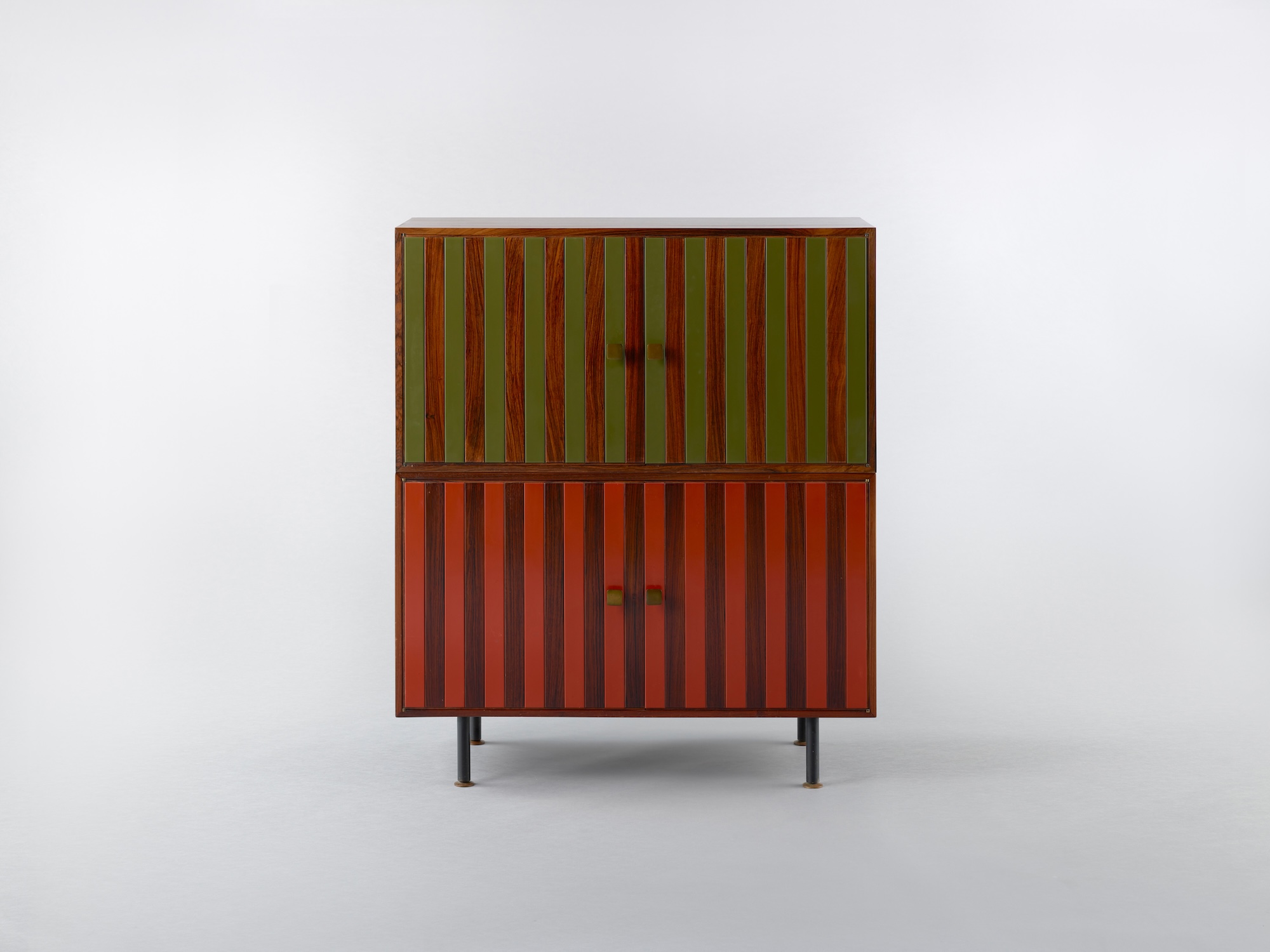
Ettore Sottsass, Mobile, designed 1957–58, produced 1959. Poltronova. Artizon Museum, Ishibashi Foundation. © Erede Ettore Sottsass. Artizon Museum
Although still grounded in the language of post-war modernism, these early pieces introduced a graphic and architectural approach that would later culminate in the Superboxes and, ultimately, Memphis. The Superboxes tend to overshadow this earlier furniture, but those first cabinets are important because they reflect the impact of Sottsass’ American experience.
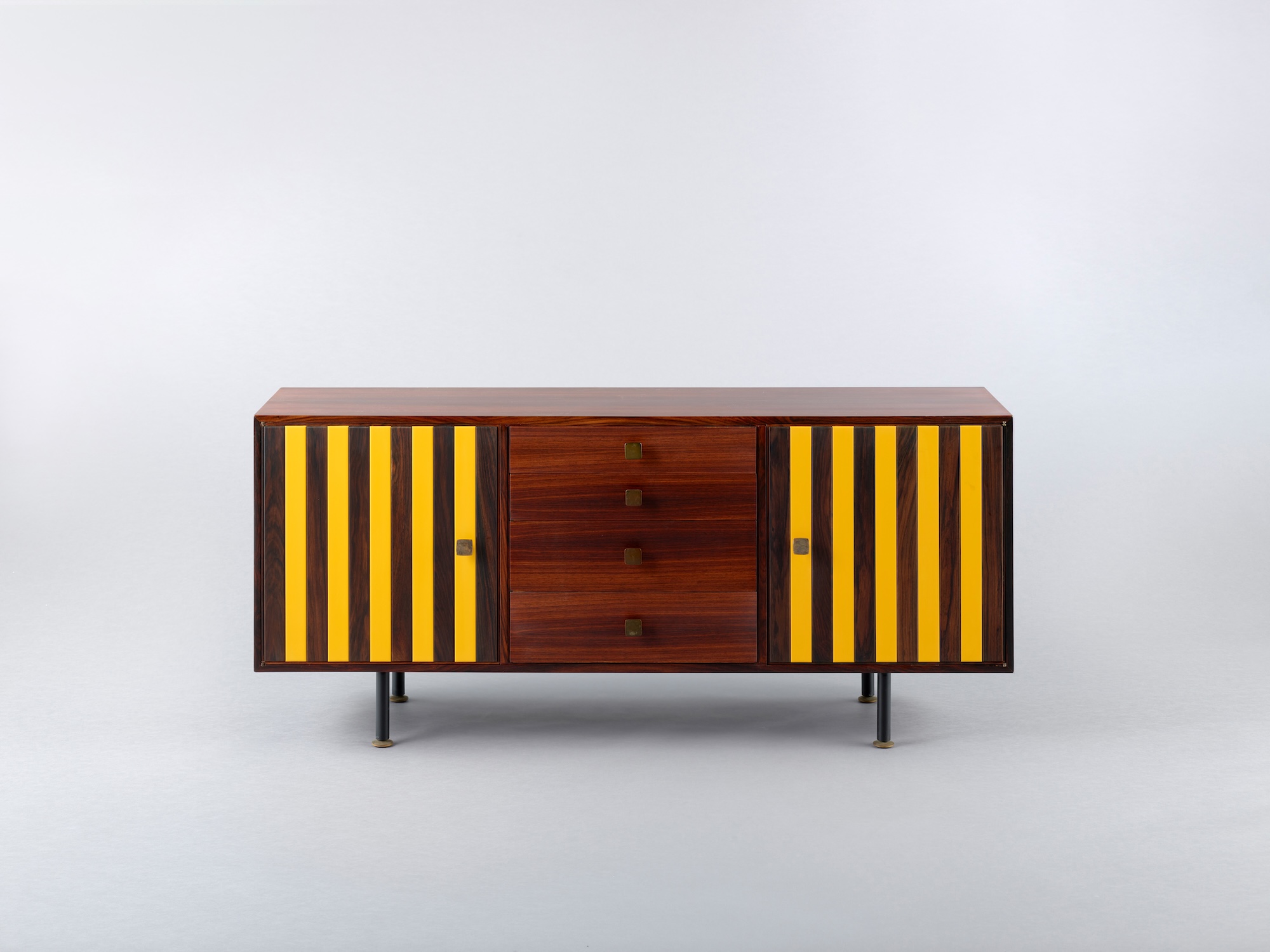
Ettore Sottsass, Mobile, designed 1957–58, produced 1959. Poltronova. Artizon Museum, Ishibashi Foundation. © Erede Ettore Sottsass
His early production for Poltronova (1957–58) consisted mainly of wooden cabinets, sideboards and storage furniture. Restrained in comparison with the later Superboxes, they reveal his growing interest in graphic pattern and in turning storage furniture into architectural compositions.

From sketch to photograph: Sottsass meticulously planned the presentation of his early Poltronova furniture, specifying the composition, colours and even the circular framing of the photograph. Long before designers routinely art-directed their own campaigns, he understood that the image of the object was part of the object itself. That idea would later become central to Memphis, where photography, graphics and exhibition design were inseparable from the furniture.
Sottsass himself referred to the Superboxes as “crazy things.” Conceived in 1965–1966, they represented a radical departure from conventional storage furniture. Instead of disappearing against a wall, the cabinet became a freestanding object – part furniture, part architecture, part totem. The earliest Superboxes existed as small models, carefully staged and photographed by Sottsass to appear as full-scale interiors, with names such as Nirvana, Il Boudoir di Jean Harlow or I Like Sex. An ordinary piece of storage furniture had suddenly become the star of the room.

Ettore Sottsass, Prototypes, 1966. Plywood and Plastic Laminate, 84x30x31 cm. Abet Print.
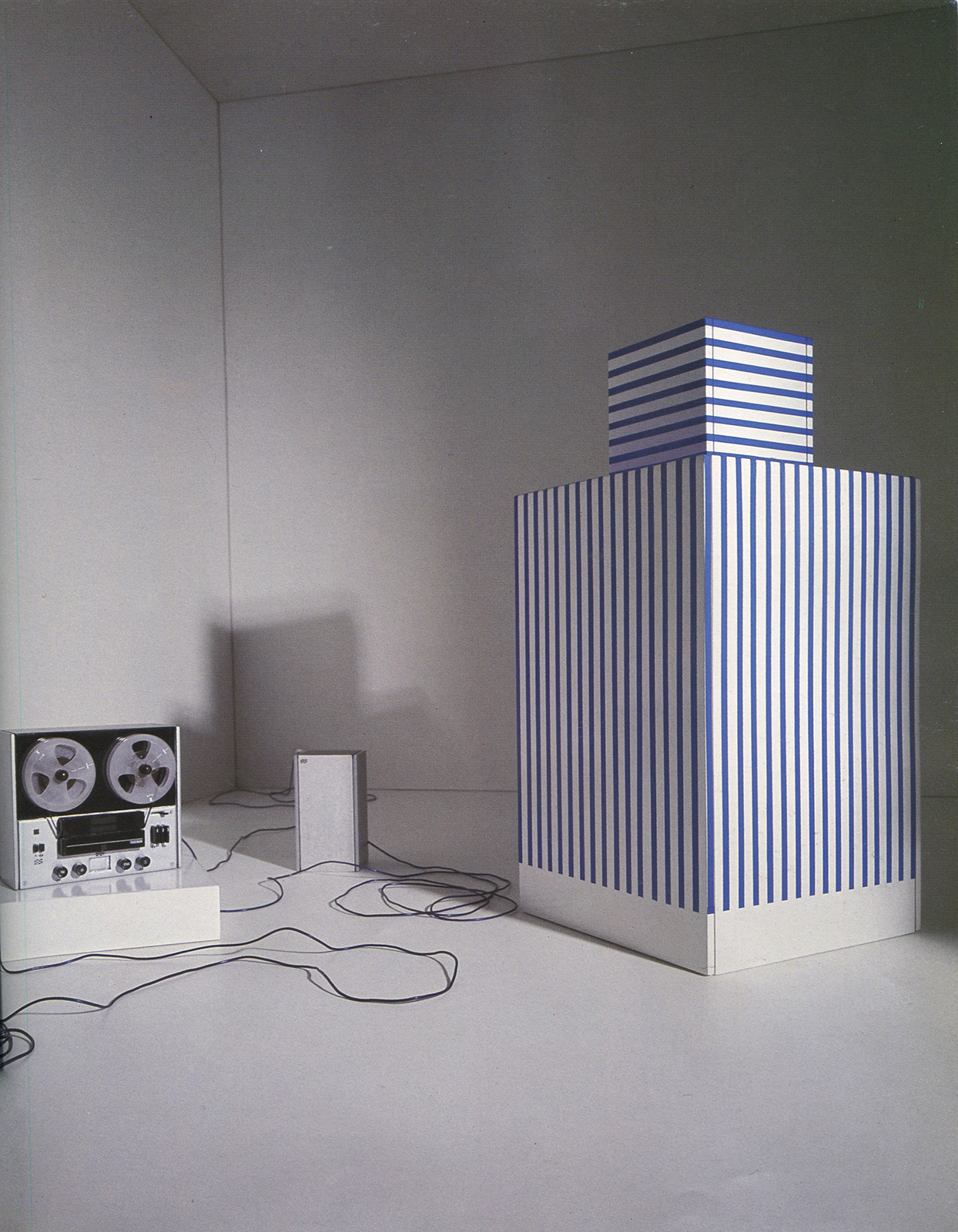
Superbox model L’Amatore del Magnetofono, 1966. Centro Studi Poltronova

The Superbox, designed in 1966, produced in 1968. Sizes differ, a documented Poltronova size example is i.e.. 200 x 80 x 80 cm.
Their striped surfaces were made from plastic laminate supplied by Abet Print (later Abet Laminati), a material until then associated primarily with inexpensive, practical surfaces.. Sottsass turned it into an expressive medium. Colour and pattern no longer decorated the furniture; they defined it.

Ettore Sottsass, autobiographical drawing, date unkonwn: “These are tower furnitures.” From Ettore Sottsass, Phaidon.
His encounters with American visual culture undoubtedly formed part of the background to this development. During his stays in the United States, Sottsass encountered the commercial colours, materials and imagery of everyday American life, including plastic laminate, widely used in kitchens, diners and other commercial interiors.
But the Superboxes also grew from another strand in his work: his fascination with monumental and ritual forms. An important influence was India, which he travelled through with Fernanda Pivano in 1961. There he encountered a culture in which particular places and objects could assume sacred or ritual significance – an experience that profoundly affected his understanding of objects.
“In India I found very strongly a sort of dimension of sacrality. Every object could become something so related to your life that it becomes […] your vision of the sacred.”

Installation view, Galleria Sperone, Milan, 1967. Centro Studi e Archivio della Comunicazione, University of Parma. © Erede Ettore Sottsass
In 1967 Sottsass exhibited related totem work under the title Menhir, Ziggurat, Stupas, Hydrants & Gas Pumps. The title brings together the ancient and the everyday, the sacred and the commercial. The same tension runs through the Superboxes.
What began a decade earlier with relatively conventional cabinets for Poltronova had become something altogether different: furniture no longer simply organised the room. It could occupy it.


Ettore Sottsass on a 1966 Superbox for Poltronova. Photo Giuseppe Pino/Contrasto, 1979. Source. Superbox, 1960s via Jackson
CONTEXT AND CONNECTIONS
Designer and Architect
Ettore Sottsass (1917-2007)
Known for
Furniture, electronics, glass, ceramics, enamel, interiors and art projects
Related Objects
Poltronova cabinets and sideboards, 1957–58
Superboxes, 1965–66
Olivetti Valentine, 1969
Carlton, Memphis, 1981
Connections
Fernanda Pivano
Gerorge Nelson
Poltronova
Influences
American visual culture
Mid-century Modernism
India and ritual objects
Associated Companies
Olivetti
Poltronova
Abet Print / Abet Laminati
Design Movement
Italian Radical Design
Memphis
Did you know?
Besides being a great writer Sottsass was also a prolific photographer. Over decades he took thousands of photographs on his travels – creating a personal visual archive that continuously fed into his work.
Further reading
Barbara Radice, Ettore Sottsass: A Critical Biography
Thames & Hudson, London, 1993
From the Archive
More about Ettore Sottsass
More to read:
Sottsass and the magic of the mobili, Francesca Balena Arista, MacGuffin
A glimpse into the visionary Brain of Design Hero Ettore Sottsass, Diana Buddy, Fastcompany

Chest of Drawers, designed 1964 for Poltronova. Indian rosewood veneer and lacquered ash wood. 113 x 59 x 101 cm. Via Sotheby’s