At the turn of the century, René Lalique (1860–1945) was well known for his exquisite handmade jewellery, when he did shift his focus on luxury glass products. One of his shop neighbours at Place Vendôme in Paris was Francois Coty, the perfumer, who comissioned Lalique in 1907 to design perfume bottles for him. This was revolutionary as before this, scent was typically purchased in small phials from pharmacies and then transferred into ordinary bottles at home. However, in doing so Lalique established a precedent for future commercial perfume presentation and packaging. And it marked a pivotal moment in his career, transitioning him from a jeweller to a renowned glassmaker.

Cyclamen is the first commercial perfume bottle Lalique created 1909 in its entirety for Coty. The initial production was made at Baccarat. Many more followed in the years to come, each one a masterpiece – both in terms of aesthetics and craftsmanship. Photo via V&A

The Althea bottle, designed in 1911, was probably never put into full production, as it was technically so challenging. Photo © Lyon & Turnbull

Fougères (Ferns), designed 1912. Mold-blown glass bottle and mold-pressed glass stopper, acid-etched, applied patina; gold foil inclusion. The Corning Museum of Glass

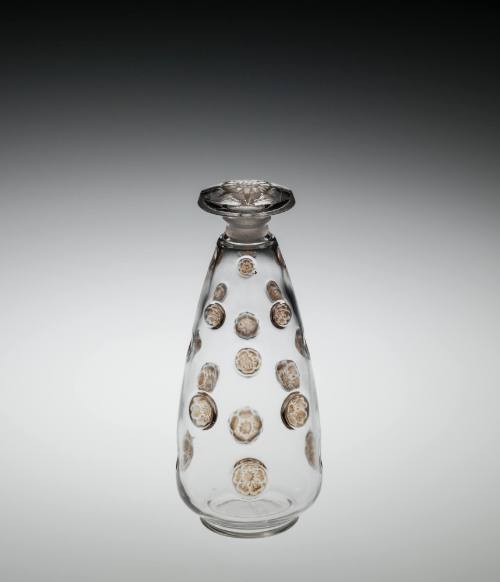
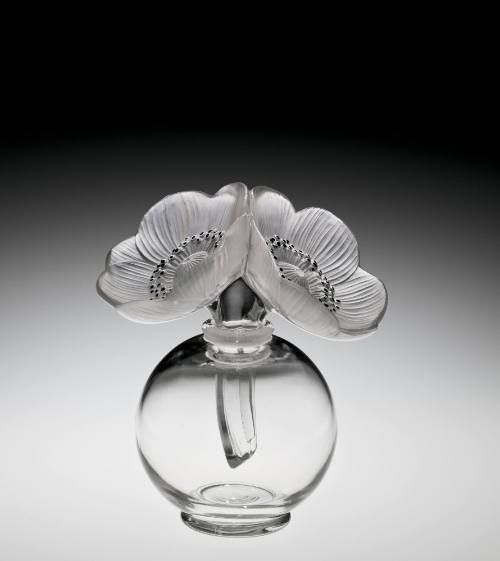
Various Perfume Bottles, designed 1912 – 1935. Via Corning Museum of Glass
Lalique designed “flacons” for more than 60 perfumiers, fashion houses and department stores plus designs for his own Maison Lalique brand – for example D’Orsay, D’Heraud, Roger & Gallet, Lucien Lelong, Arys, Molinard, Houbigant, Forvil and Worth, and department stores such as Saks of New York and the Grand Magasin Du Louvre in Paris.
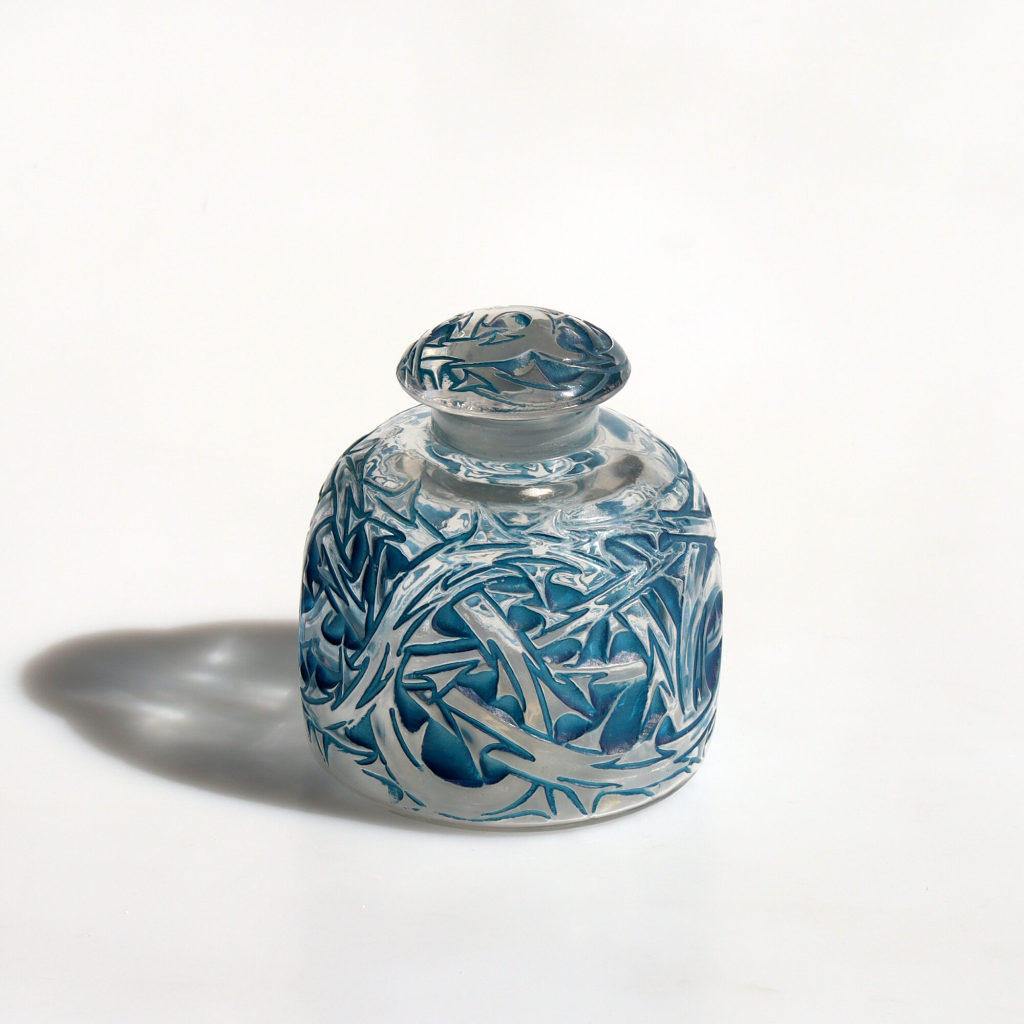
Épines (Thorns), 1920. Photo Kunstpalast Düsseldorf
Lalique’s innovative techniques and patents enabled him to create perfume bottles on a larger scale. By 1909, he had already filed his first patent related to glass, which facilitated the mass production of his designs away from “Arts and Crafts”. This technological advancement, combined with his artistic power, allowed him to produce a vast number of bottles, According to reliable sources, Lalique created several thousand bottles in over 250 different models.

“Camille” or “Torsade”, 1927. Photo Kunstpalast Düsseldorf
“René Lalique is a pivotal figure in the history of late 19th- and early-20th-century glass, he designed decorative glass for every part of the home, he was seminal in the early success of the French perfume industry, he introduced decorative glass into architecture, luxury trains and cruise ships, and he established a legacy of excellence and innovation in luxury glass production.”
Kelley Elliott, The Corning Museum of Glass.

Canarina – 1, Les Yeux Bleus, designed 1928. Made of transparent Cobalt Glass. The Eyes have been etched to give a matte surface. The name Canarina appears on the stopper and packaging, but it is unclear who is the brand or company.

“Perfumes A, B, C, J ou N, 1929. For Lucien Lelong, Paris. © Christie’s.
The couturier Lucien Lelong (1889-1958) launched a perfume house in 1924. At his side was his wife and model Nathalie Paley, a cousin of Tsar Nicolas II. Together they opened two stores in the United States, one in Chicago and the other in New York. He commissioned René Lalique to design a bottle reminiscent of the skyscrapers for his american clients – clearly inspired by the Art Déco architecture of the Chrysler Building.The perfume bottle was part of a set including powder case, comb, brush or mirror.

Imprudence, 1938, Photo Kunstpalast Düsseldorf
In 1921, René Lalique opened a new glass factory, in the historic glassmaking town of Wingen-sur-Moder (in Alsace). The factory began using a more efficient manufacturing method known as glass-pressing. Using a steel mold into which molten glass was poured and a hand-operated pressing machine, Lalique produced radiator caps for automobile enthusiasts as well as ashtrays marketed to the new women of the 1920s who had adopted smoking. Via Corning Museum.

Perfume bottle and powder box Cactus for Maison Lalique, designed 1928, production after 1943. Photo: Kunstpalast, Düsseldorf


The Lalique Museum in Wingen-sur-Moder, where he established his glassworks in 1921, houses a collection of over 650 exceptional pieces, including his iconic perfume bottles. Photos Musée Lalique

Bouchon mûres (Berry stopper), designed in 1920. Via Corning Museum of Glass
 Design is fine. History is mine.