Ukiyo-e, the Japanese woodblock print tradition captured the “floating world” of daily life – no wonder that cats quickly became favorites among its recurring motifs, as they were associated with good luck, prosperity, domestic calm and a connection to the spiritual world.
But they were not only portrayed as cute pets but also as monsters, dancers, actors or children. Some prints showed the imagined life of a female cat, while others doubled as protective charms to ward off mice. Masters like Hiroshige, Kuniyoshi, and Yoshitoshi captured their feline subjects with elegance, charm or humor.

Utagawa Kuniyoshi, Picture with Cats, mocking the Names of the Stations of Tōkaidō, 1848. Source Kunstpalast Düsseldorf
Utagawa Kuniyoshi (1798–1861) had a special fondness for cats, he produced numerous feline works. In this woodcut each cat represents one of the Tōkaidō stations, written in kanji in red cartouches, puns on these names are shown in hiragana, with the cats playfully joining in. The station Kusatsu, for example, has the caption kotatsu (heated table) and is depicted as a table with a cat sleeping on a green tablecloth. Or the station Miya: This name sounds somewhat like the Japanese word oya which means ‘parent’. For this reason, the station is depicted in the upper left corner as two kittens with their mother.

Humorous Picture with Cats, the complete triptych, 1848.
Kuniyoshi lived surrounded by cats – sometimes just a few, sometimes a dozen or more. Guests often saw him painting with one curled up inside his kimono. His apprentice Yoshimune remembered that whenever a cat died, Kuniyoshi sent it to a Buddhist temple and honored it at a home altar, even giving the cats posthumous Buddhist names and enshrining their memorial tablets.
Another pupil of Kuniyoshi’s was Kyosai and he depicts the chaotic studio with cats and other artists milling around in his illustrated book “Kyosai Kadan” of 1887.

Utagawa Kuniyoshi, 4 cats in different poses illustrate Japanese proverbs, 1852.
The content of the proverbs: 1. Putting dried bonito in front of a cat: creating a risky situation – the cat likes bonito and will eat it if given a chance. 2. To put a mallet to a cat’s butt: choosing a method that’s too grand for our goal – the cat was unruly, but it didn’t deserve being hit on the butt with a mallet. 3. Coin before a cat: pearls before swine – the cat doesn’t understand the value of the coin (that’s how coins looked in Edo period). 4. Hiding a cat: hiding one’s true (bad) nature behind a mask of obedience.

Utagawa Kuniyoshi, Printed Cat to keep mice away, 1842.
Bob-tailed and calico cats were common in the Edo period.

Utagawa Hiroshige, Rice fields in Asakusa and the Torinomachi Festival, plate 101 from the series: 100 Famous Views of Edo, 1857. Via MKG Hamburg, public domain
Hiroshige depicts a white cat on a windowsill, a symbol of domestic calm, it is drawing the viewer’s eye and attention to the distant Mount Fuji and the lively Torinomachi Festival procession below.

Tsukioka Yoshitoshi, Teasing the Cat, 1888. Woodblock print; ink and color on paper. Via Met Museum

Shotei Hiroaki (1821-1945), Tama (the japanese name for cat), 1926.
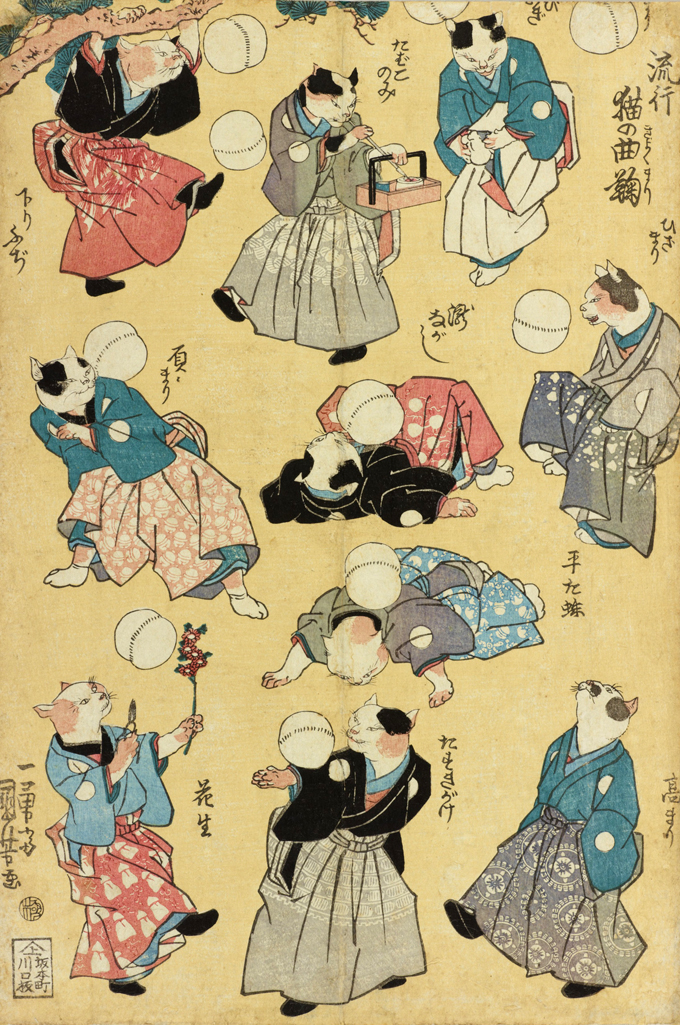
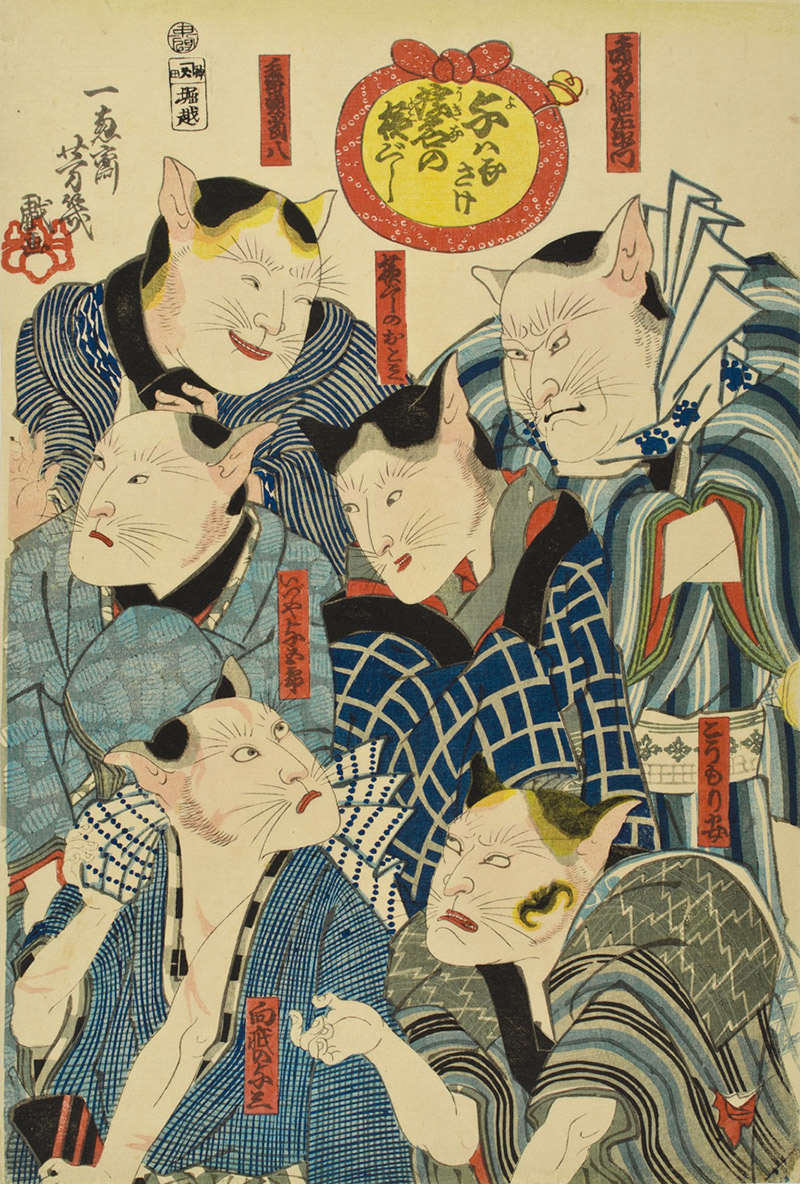
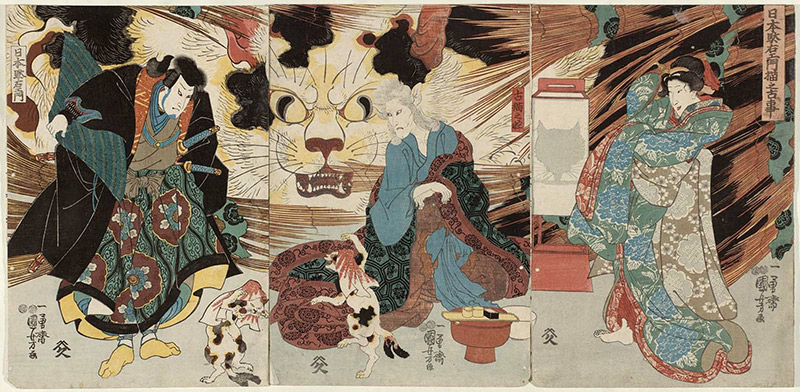
More cats of all kind by Kuniyoshi:


 Design is fine. History is mine.