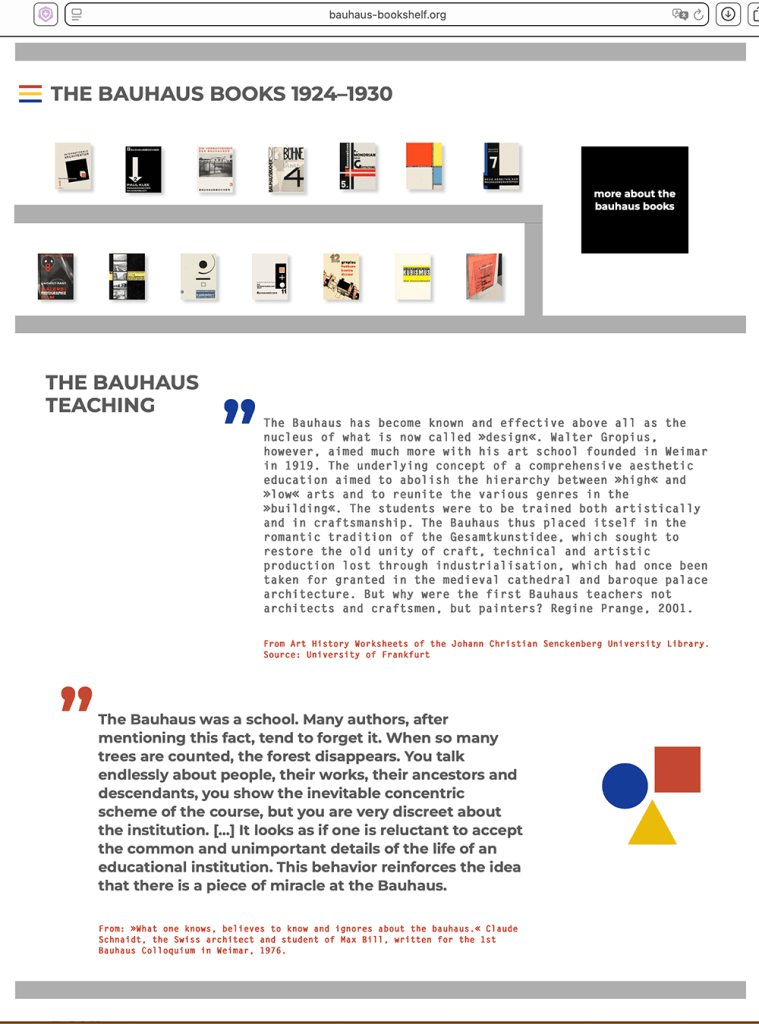
The bauhaus bookshelf archive is my labor of love. The website combines access to reproductions of original Bauhaus publications with a timeline, editorial excerpts, photographs, and other contextual info. My USP: the bauhaus bookshelf is the only comprehensive online gateway to original Bauhaus publications and sources.
The following interview was conducted with the German Historical Institute Washington in 2019 for their blog.
1. What inspired you to develop the bilingual bauhaus bookshelf?
Some time ago, I began teaching design history as a lecturer alongside my regular career. I had worked for various design companies during my career in communications consulting. However, studying and teaching design history was a new field for me, even though it had been a long-standing passion of mine.
The Bauhaus as a German institution has always been close to my heart; it fascinated me even as a child. I grew up in Stuttgart and during my school years, our art class made visits to the Staatsgalerie, the museum where Oscar Schlemmer’s figures of the Triadic Ballet are on exhibit. That was my first encounter with the Bauhaus and it left a lasting impression, also thanks to good art teachers.
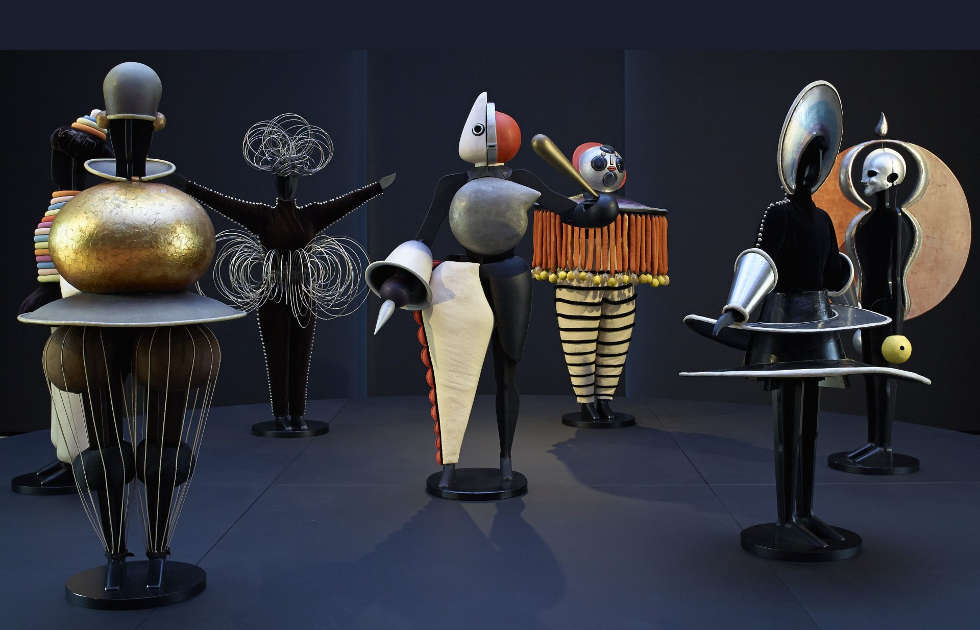
Oskar Schlemmer, figurines for the Triadic Ballet, 1922, various materials © Staatsgalerie Stuttgart, on loan from the Friends of the Staatsgalerie
Last year (2018), I began collecting my Bauhaus discoveries on my own website; first there were a few books and interesting publications, then it became more and more of a mission: a collection of sources that can be downloaded free of charge. Bauhaus knowledge for everyone. The anniversary was an additional incentive to launch the project in a timely manner.
2. How did you proceed with your research? Which publications and sources were you looking for? Did you research only online or also in analog collections?
The original sources from the Bauhaus period formed the basis for the site, complemented by publications by Bauhaus members or affiliates, or other contemporary witnesses. Initially, I relied on online research, as availability on the Internet was a mandatory prerequisite. Once the framework was set and the attention could go into the details, I was able to fall back on my own small Bauhaus library. The catalogue of the 1968 Stuttgart exhibition, for example, was an excellent source, and since I also own a copy of the English-language edition, this proved to be of great help in translating the typical Bauhaus terms. This catalogue, by the way, is not available online, so sometimes you can’t get around the analog versions.
3. Which discoveries did you particularly enjoy, or which ones particularly surprised you?
A highlight was the first catalogue book on the exhibition in Weimar, whose title page and contents I had seen frequently. Under the umbrella of the SLUB Dresden, I finally found what I was looking for: browsing through and studying the entire work at my own pace for the first time, and the whole thing available in rather good quality, was a wonderful moment – many thanks to Dresden! Also the complete edition of the journal “Form,” provided by the University of Heidelberg, are a great way of immersing oneself in the bustling twenties, including the world of advertising.
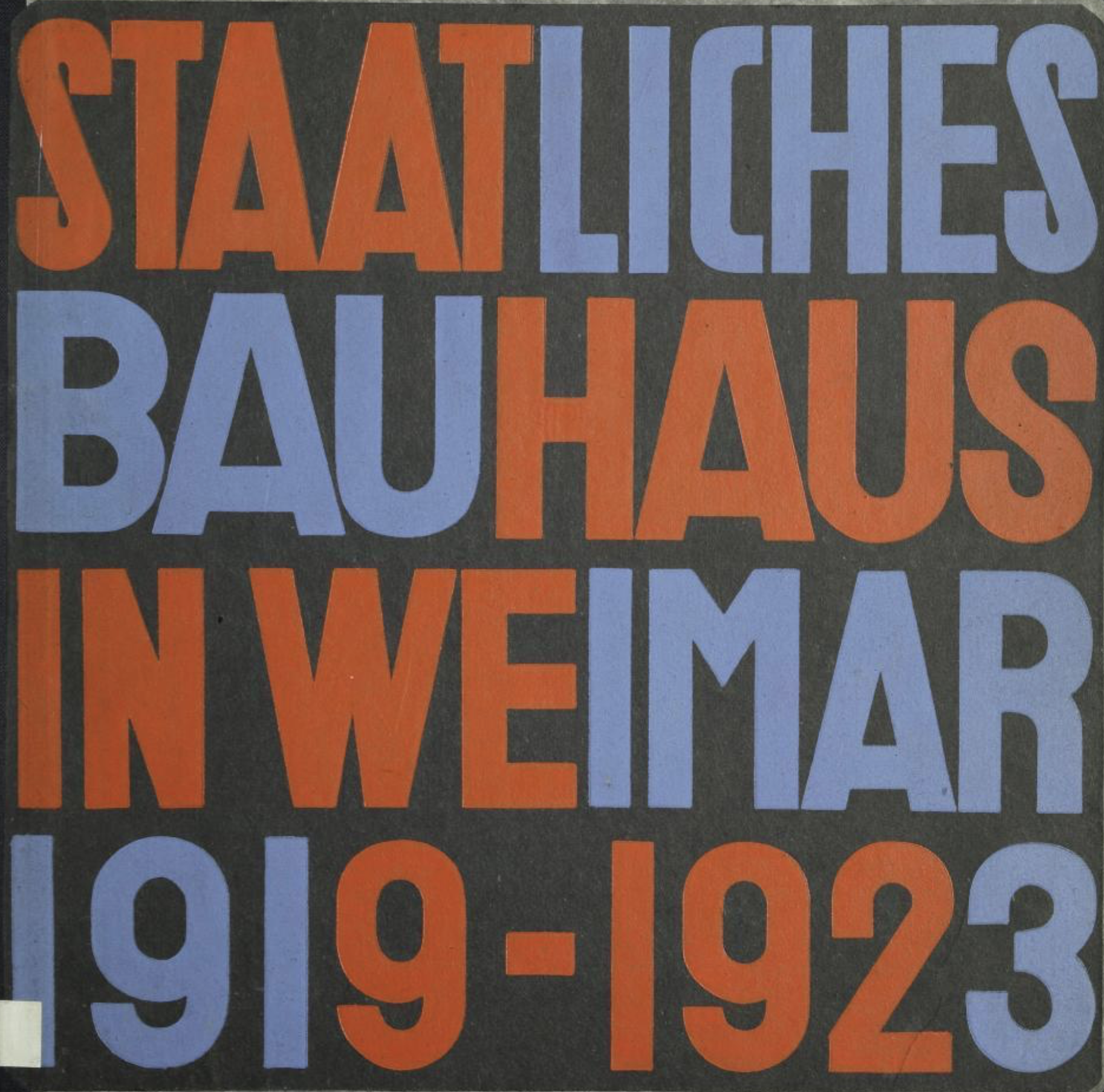
Documentation of the early achievements of the Bauhaus movement. The cover was designed by Herbert Bayer with its letters stripped of all ornamental elements; the inside layout was designed by Laszlo Moholy-Nagy.
It is also pleasing to note that my work resulted in the online publication of the original English-language version of a lecture held by Ise Gropius at Harvard in 1978. I had first discovered the text in a German translation published by the GDR magazine “form und zweck.” With the help of the Harvard archives, I received the original script, which I diligently typed before placing it on my virtual bookshelf. It is worthwhile to read the article by “Frau Bauhaus,” as she was called then.
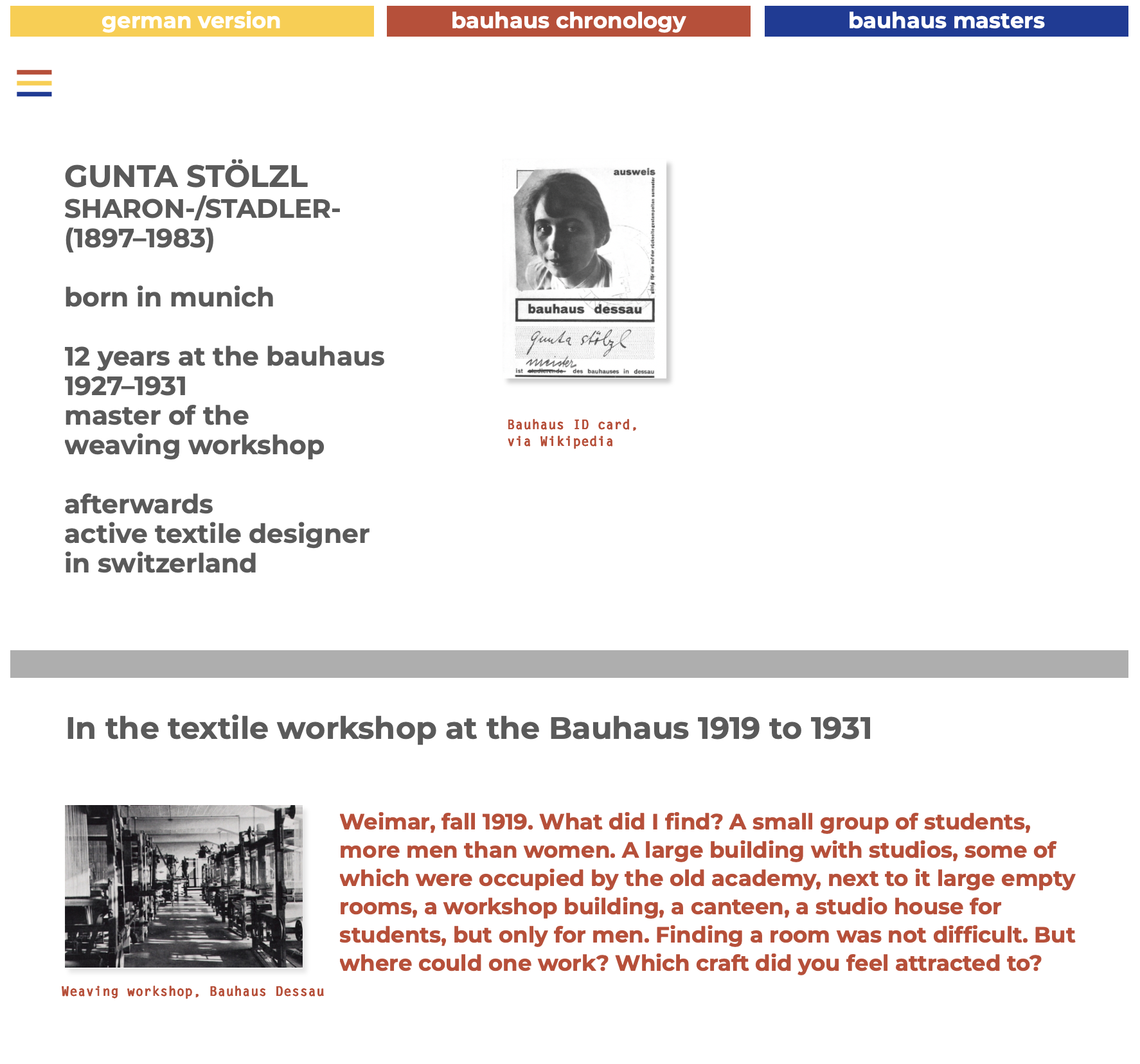
4. One of the focal points of the centennial is on highlighting the history of the women associated with the Bauhaus. What challenges did you notice in the course of your research?
Of course, the theme of the Bauhaus women is a topic close to my heart. In general it is important to me that I introduce and revive those women in my history lectures who have been “forgotten” for centuries, be it Sappho or Sofonisba Anguissola. As far as the Bauhaus is concerned, Anni Albers, Gunta Stölzl and Marianne Brandt have been among the well-known personalities for quite some time, and there are new publications on Ise Gropius, for example. While studying the Bauhaus books and magazines I noticed works by Hilde Hubbuch, Rosa Berger, Hilde Horn or Lotte Burckhardt, but one can find little or no information about these individuals. Lou Scheper-Berkenkamp and the architect Wera Meyer-Waldeck are known merely by a small circle and deserve more attention. Initial results of a study about Michiko Yamawaki, who studied (alongside her husband Iwao, an architect) in the weaving workshop at the Bauhaus and later made the “bauhausu” known in Japan, were presented at the beginning of 2019 as part of the anniversary. To date, there has been little known about Yamawaki in German-speaking countries. There is interest on many sides to learn more about these women, who have not been that well-known so far, and to honor their work.

5. Your site is not only a list of links, but also a small online exhibition with short portraits and excerpts from original publications. Which themes did you want to emphasize when conceptualizing your website?
Presenting the entire diverse spectrum of the Bauhaus was a matter of concern to me, but just as important for the orientation are focal points. The Bauhaus was a school. Artists taught at the Bauhaus. There were many strong personalities at the Bauhaus (and thus there were conflicts). The Bauhaus was arts and crafts, theory and practice. At the Bauhaus, there were many new developments – not only in architecture or product design, but also in photography, typography, advertising, PR. While the Bauhaus was forced to cease operations (in 1933), in some ways this was just the beginning. If just one issue sticks to the minds of site visitors, then my mission has already achieved a lot.
6. What were the particular challenges in developing and designing the chronology?
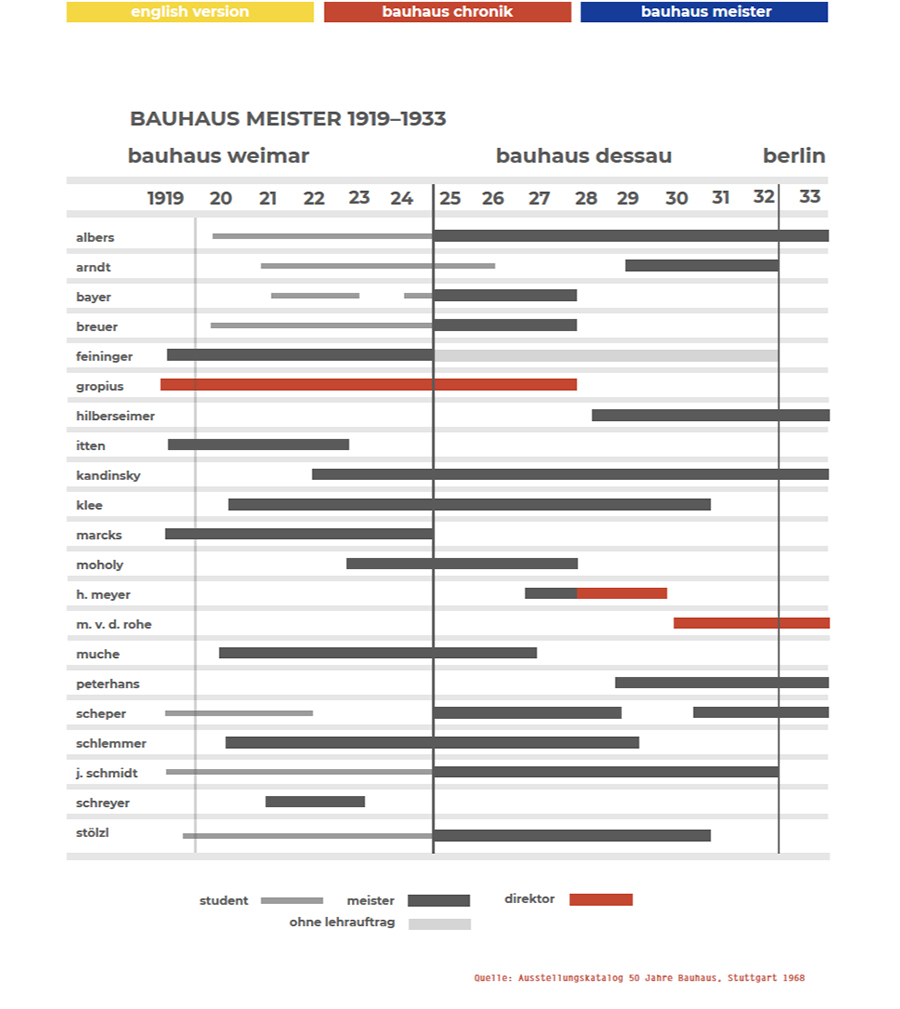
Designing the structure of the website chronologically seemed obvious and sensible, as it provides a helpful thread leading through the entire range of topics. Since I did not proceed strictly according to plan, I ended up always interspersing something thematically that was situated “in between,” which suddenly opened up different contexts – the work certainly was never boring. Visually, in this context, infographics are important to me, and they have been realized for example on the pages “Bauhaus Chronology” or “Bauhaus Masters.” Who was active at the Bauhaus for how long? The 1968 exhibition catalog, which was coordinated by Bauhaus members still alive at the time, provided a perfect model for this infographic.
7. Which principles inspired your web design?
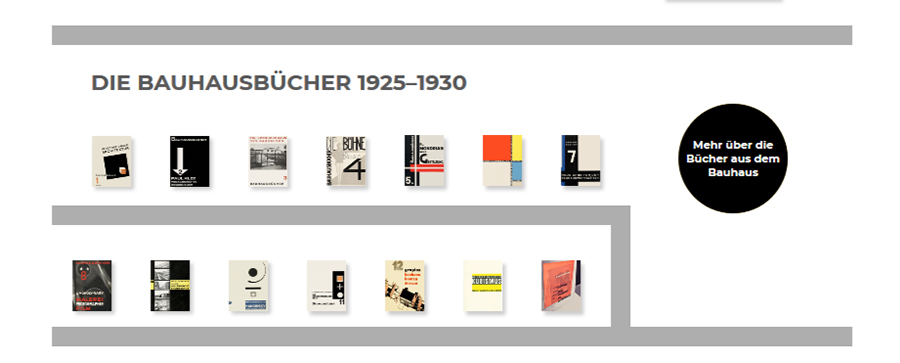
At the beginning there was no defined concept, the website was created according to the principle “learning by doing,” for fun. The site arrangement developed in the process; as more and more content was integrated, the appearance emerged in the process of creation. One inspiration for the graphic design was, for example, the photo of a bookshelf that Josef Albers designed in Weimar at the beginning of his Bauhaus period (reproduced in Bauhaus book no. 7/page 18). The character of the appearance was to be just as geometric, balanced and solid. And up to today, one can still learn a thing or two from Moholy-Nagy’s graphic art.
8. What are the challenges of transferring the historic Bauhaus design into a digital environment?
It is actually easy to design in the Bauhaus style, the modern look still corresponds to our viewing habits, “Less is More” is timeless. What matters is a clear and consistent grid as the basis, a nice and tidy arrangement, no frills. The primary colors serve as accents, or one can choose the combination black-white or black-red. Square and circle as style elements are, of course, a must, whereas I neglected the triangle, just my personal taste.
9. What do you particularly enjoy about curating the Bauhaus bookshelf?
It’s fun that it’s actually a story that never ends; I don’t feel that the work is “finished” yet. There are so many protagonists, texts, or events that are interesting, my folders on the hard drive are filled with content. I will expand the shelf throughout this year, at least, whenever I get to do the work. The work on this virtual library is a hobby, which is limited to the evening hours, unfortunately. It would be nice if I could earn money with it, being a freelancer, then I’d be able to work on it even more. At the same time, that’s also a lucky advantage: having the independence to work on my library as I please, while certainly serving the cause of sharing the best Bauhaus sources with the public.
Interview for Blog Href, GHI Washington 2019.
The website Bauhaus Bookshelf was launched in 2019, celebrating the Bauhaus centennial. It is a bilingual (German-English) online resource created by Andrea Riegel, a partner at the Düsseldorf-based communication design agency Riegel+Reichenthaler.
Andrea Riegel is also running this site you are visiting right now (you did read til the end, wow!), a popular blog on design and art history
 Design is fine. History is mine.