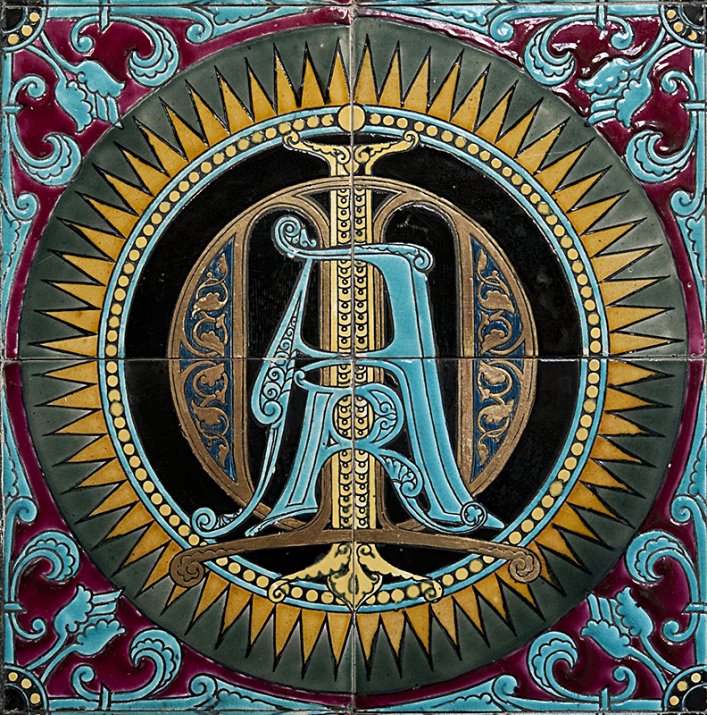
The history of tiles begins with bricks. Air-dried or fired, they were used as simple flooring in ancient Egypt as early as around 2000 BC. Between Mesopotamia, Persia and India, they were later used as wall decoration after being glazed. In the course of the Roman conquests, these then spread as floor tiles throughout the Mediterranean region and also north of the Alps. After the end of the Roman Empire, the tile lost its importance and knowledge of the craft was in danger of being forgotten.
It was not until the Islamic conquests on the Iberian Peninsula until the eighth century that the art of ceramic tile production in Europe was revitalised. The Crusades and, above all, the European reconquest of Spain and Portugal made tiles popular again in Europe. The colourfully painted and glazed ceramic tiles on the Iberian Peninsula and particularly in Andalusia were called azulejos, which does not refer to the later blue colouring, as many derive from the Spanish (azul = blue), but, derived from the Arabic-Hispanic, means ‘glazed clay’.
The technique of colourfully painted ceramic firing reached Italy via the island of Mallorca, an important trading post in the 14th and 15th centuries. There the ceramics, named ‘majolica’ after the old Italian word for Mallorca, were imitated. The main production centre was the northern Italian city of Faenza, from where the technique spread throughout Europe via France, the Netherlands and Germany. This is why the term ‘faience’, which originated in French, is used today for this ceramic technique.
The lively East India trade, which began with the Portuguese opening up of the sea route to India from the beginning of the 16th century, but above all with the founding of the British and Dutch trading companies in the 17th century, brought high-quality Chinese porcelain to Europe. The traditional white and blue colouring of the Chinese export hit became a symbol of wealth, sophistication and luxury. Blue painting became a profession in its own right in many parts of Europe, but the fact that the Bavarian national colours are said to have been made in China is a modern, unproven myth, even though blue and white tiles were used in Munich’s Nymphenburg Palace.
The fascination with China continued well into the 18th century and many resourceful producers tried to capitalise on the fashion with imitations. At the beginning of the 17th century, manufactories in Delft in the south of Holland succeeded for the first time in producing relatively equivalent porcelain-like ceramics, which could be produced much more cheaply in the country than the Asian porcelain pieces shipped thousands of kilometres on sailing ships. The ‘Delft Blue’ stuck to the blue and white colour scheme not only for fashion reasons, but also because the two-tone colour was cheaper to produce than the often multi-coloured faience ceramics from the Mediterranean region.
The tiles in the style of so-called ‘Dutch porcelain’ were reimported back to Portugal. The local azulejos manufacturers followed the new fashion in the 18th century and now also produced the large-scale local tile paintings in blue and white, which then promoted the often incorrect translation. Today, Portugal is recognised by tile connoisseurs as the country with the most tile wall coverings in the world.
Source: Monumente Online
 Design is fine. History is mine.