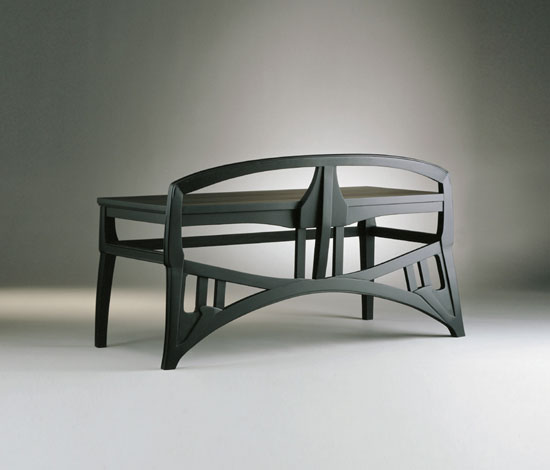
Henry van de Velde, piano bench for Maria van de Velde, 1902
Like the tea table or occasional table ‘Curt Herrmann’, this piano bench dates from 1902. It was verifiably commissioned for the music-room in the flat kept by Karl Ernst Osthaus in the ‘Folkwang’ Museum he founded in Hagen.
Henry van de Velde’s exclusive clientele viewed itself as a cultural elite and this status consciousness was not least reflected in the commissions given to the Belgian designer. This was a circle in which literary and artistic interests reigned supreme and both classical and modern music were cultivated. Even though van de Velde’s new designs for sculptural concert grand pianos (for Karl Ernst Osthaus and the Weimar Nietzsche Archives) were not so successful, the piano bench was ordered by several clients. Helene von Nostitz and Sophie Herrmann, to name two of them, were gifted pianists and so was Maria van de Velde, who before her marriage had wanted to become a concert pianist.
The 1902 piano bench attests particularly eloquently to the artist’s fresh start at Weimar. The fluid ornamental line of the early work he did in Brussels and Berlin has yielded to a dynamic created solely by the tensions of tectonic construction. Van de Velde’s artistic creed, ‘Line is power’ is echoed eloquently in the harmonious design of this felicitous piece of furniture.
 Design is fine. History is mine.