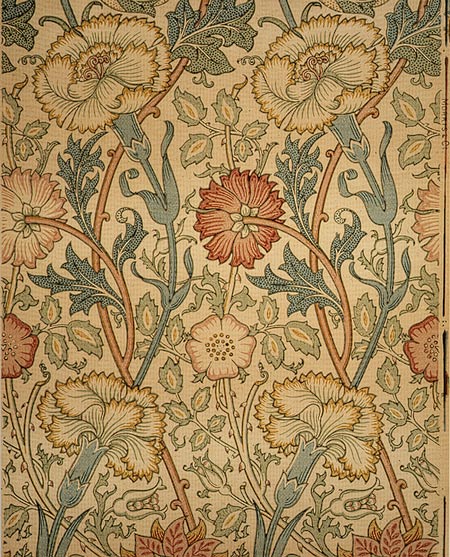
William Morris (1834-1896), “Pink and Rose” wallpaper design, ca. 1890. Hand-block-printed
Henry James described William Morris as “the poet and paper-maker”.
Indeed, despite his many designs for stained glass, textiles, tapestries, furniture, and books, it is for his wallpapers that Morris is best known today. He turned to nature for inspiration, seeking to “turn a room into a bower, a refuge.” The English countryside, with its hedgerows and native field and garden flowers, remained his touchstone throughout the period of over thirty years during which he designed wallpaper.
Beginning in 1862 with the firm Morris, Marshall, Faulkner & Co., and later, on his own with Morris & Co., Morris designed forty-one wallpapers and five ceiling papers. “Pink and Rose,” from about 1890, is typical of his late style, which is characterized by naturalism and a clearly articulated repeating pattern.
Morris believed that beauty, imagination, and order were the essential components of a successful design; all three elements are evident in this example of his wallpaper.
 Design is fine. History is mine.