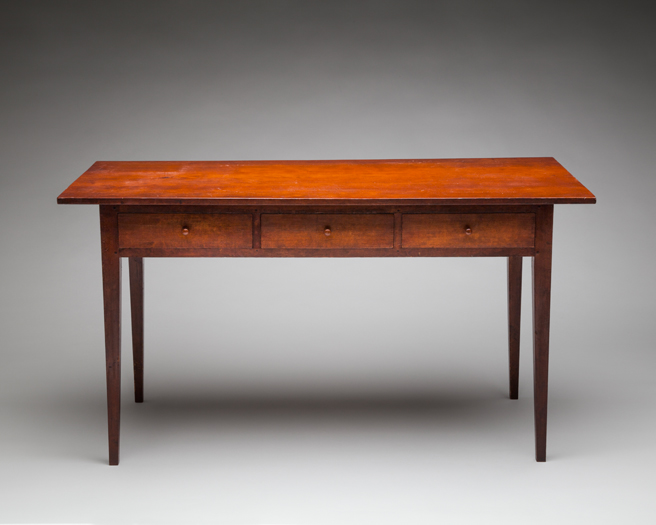
Shaker Design. Table, 1840-50. Mount Lebanon, NY. Benjamin Rose Collection, photos SFO Museum.
Woodwork
Many skilled woodworkers joined Shaker communities. Their furniture quickly became known for its remarkable precision and painstaking workmanship. Shaker furniture makers and workshops paralleled their worldly counterparts. Historically, carpenters were responsible for building construction. Joiners crafted furniture that required fastening wood parts together with various joints such as mortise-and-tenon and dovetails. Turners, commonly associated with chair production, operated lathes for turning wood to make columned shapes such as chair legs. Woodworkers used hand tools to make furniture until machinery, such as circular saws, were introduced in the second half of the nineteenth century. Even so, craftsmen finished much of their work by hand.
In the first half of the 1800s, the growth of communities created the need to furnish dwellings with chairs, beds, stands, chests, and other basic items. Shaker woodworkers also concentrated on building specialized forms to suit their community’s needs. Living and working in large communal families required furniture designed for groups rather than individuals. Long work counters, benches, dining tables, large cupboards and built-in storage units were some of the more common forms of communal furniture produced in Shaker communities.
 Design is fine. History is mine.