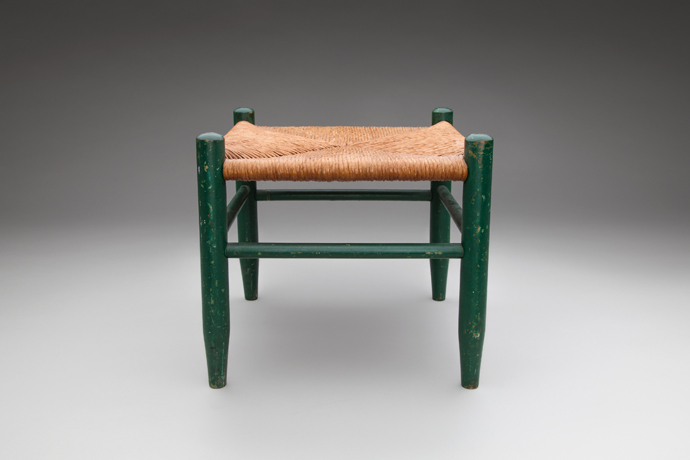
Shaker Design. Stool, c. 1850. Mount Lebanon, New York. Made for the Community. Benjamin Rose Collection. Photo SFO Museum.
Shaker Finishes
Throughout their history, the Shakers applied paint, stain, and varnish in various combinations to furniture. These coatings not only enhanced the pieces aesthetically, but also increased their longevity. Many early furnishings were covered with opaque coats of paint. In the late 1700s, when communities first began making furniture, until after the Civil War, ready-made paint was unavailable to Shaker craftsmen and their worldly counterparts. Various pigments and oils had to be laboriously mixed and ground by hand. The Shakers purchased many of their paint components from outside sources.
During the 1830s, craftsmen began to thin the paint so it resembled a stain rather than a heavy opaque coating. This clever technique enabled the fine wood grain to show through. Varnishes with a light hue also began to be applied in the 1830s. Typically, a paint or wash was applied to a piece of furniture, followed by a clear coat of varnish. This final coat protected the initial finish and in some cases added a glossy sheen. Because furniture was often refinished to keep it looking its best, many Shaker pieces have several coats of varnish or paint.
 Design is fine. History is mine.