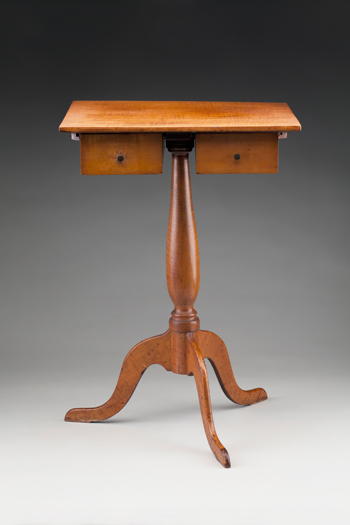
Shaker Design. Sewing Stand, c. 1840. Enfield, Connetcticut. Made for the Community. Benjamin Rose collection, photo SFO Museum.
Textiles
Shaker women were responsible for the majority of textile work from spinning, weaving, dyeing, sewing, and knitting to mending, darning, washing, and ironing. Communities raised sheep for wool and grew flax to make linen. Shaker brothers in many communities constructed spinning wheels for community use and for sale. Sisters made many of their own textiles, such as clothing and bed linens. Fiber processing and cloth production was done by hand until mechanization was developed. For instance, a Shaker community might have continued to raise sheep, but sent their wool out to nearby carding and spinning mills when they began operation. The Shakers also purchased a great deal of cloth from the outside World. In 1824, in Sabbathday Lake, Maine, community members invented a method of making cloth wrinkle-resistant. They treated cotton or wool fabric with a zinc chloride solution, then pressed and applied heat to the fabric.
 Design is fine. History is mine.