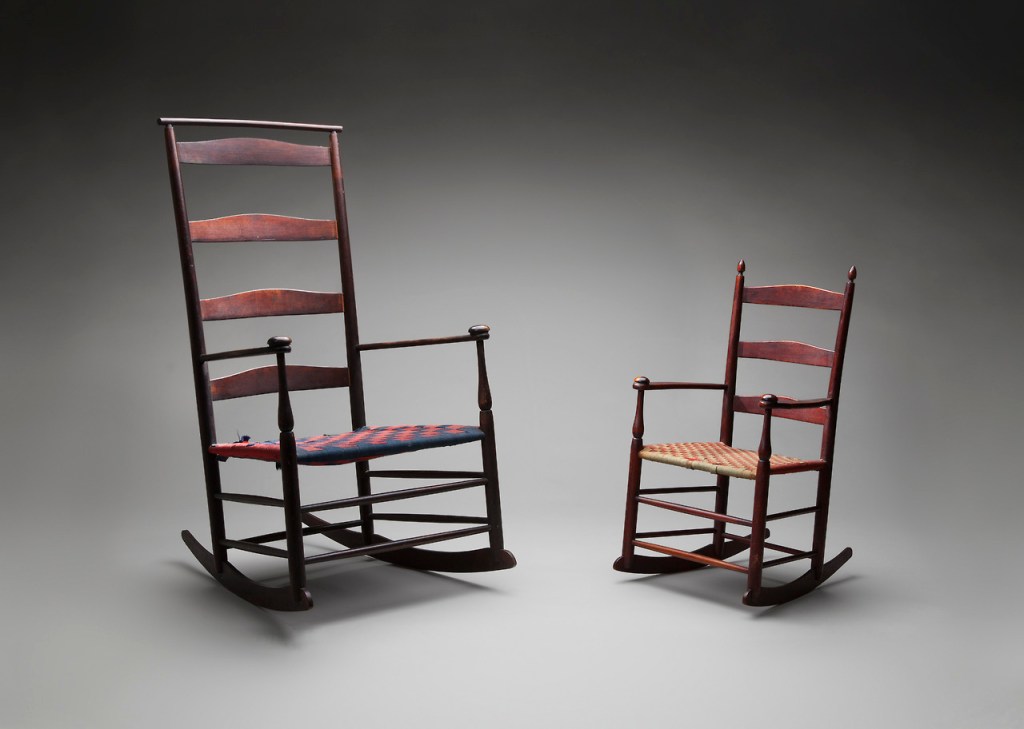
Shaker Design. Rocking chair, 1870-1875, Mount Lebanon, NY. Child’s rocking chair, 1880-1920. Photo SFO Museum.
Rocking chairs were originally made for the elderly or infirm in the early 1800s before they became commonplace in Shaker communities from New England to Kentucky.
Production Chairs
At Mount Lebanon, New York, thousands of chairs and footstools were produced for sale to the outside World to benefit the community. The use of power machinery facilitated the mass production of chairs and the standardization of sizes. Brother Robert Wagon (1833–83) played a pivotal role in the coordination of chair making in Mount Lebanon. He developed a numbering system according to chair size. Zero represented the smallest child’s chair and number seven, the largest adult chair. The number was typically stamped on the back of the upper slat. In the early 1870s, illustrated catalogs were published in order to advertise production chairs. Shaker chair making was further popularized following the Philadelphia Centennial Exposition of 1876. The Shakers exhibited a display booth at the Exposition and were awarded a medal for their chairs. Shaker chairs were sold as far west as Chicago and were imitated by many worldly manufacturers. By the early 1900s, as Shaker communities grew smaller, chair production began to steadily decline.
 Design is fine. History is mine.