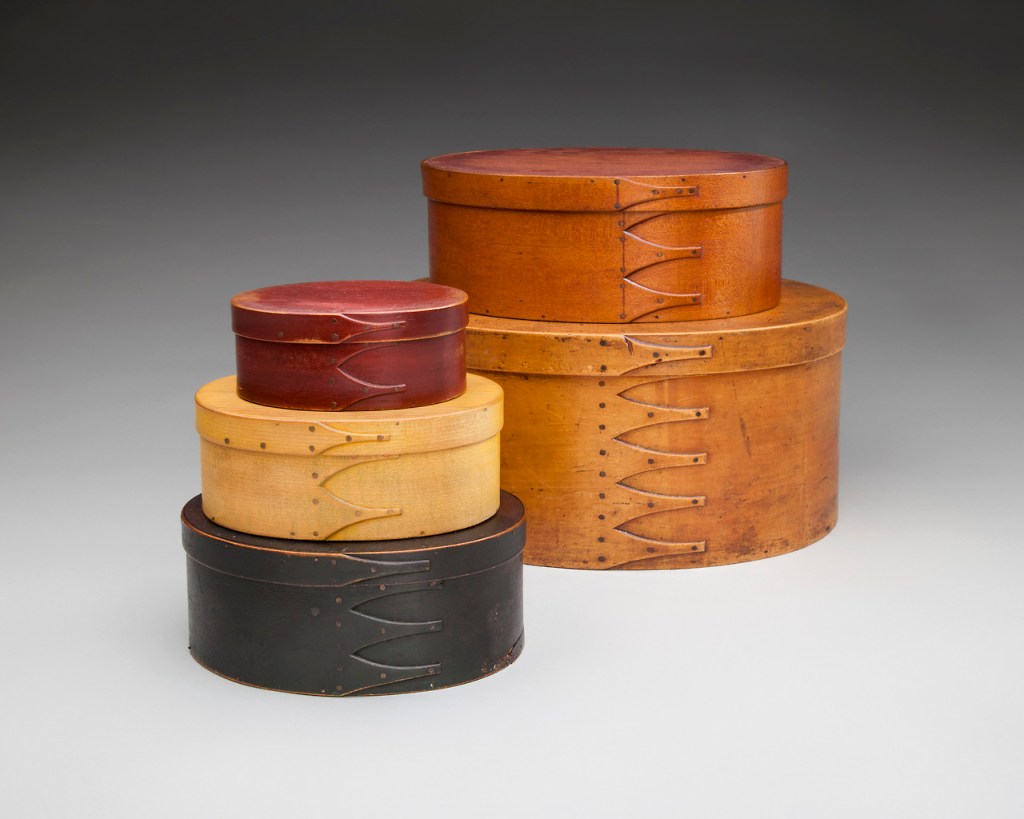
Shaker Design. Oval boxes, ca. 1830-50. Canterbury or Mount Lebanon. Made for the Community or the World. Wood, Stain, Metal. Benjamin Rose Collection. Photo SFO Museum.
Oval Boxes
The oval box, a quintessential Shaker form, had a long history in Europe and America prior to its popularity as a Shaker-made good. The Shakers, however, did perfect the form, producing boxes with uniformly slender sides, symmetrical joints, and tight-fitting lids. The oval shape may have partially developed for economical reasons. A twelve-inch circular box must be made from a twelve-inch board, but a twelve-inch oval box can be made from a nine-inch wide board. The Shakers first began to make oval boxes at the turn of the nineteenth century.
Early boxes were made using hand tools; later on, the Shakers used circular saws to cut the sides, rims, tops, and bottoms of the boxes. The sides and rims were usually made of maple and the bottoms and tops of quarter-sawn pine. Pieces were soaked in hot water or steamed until they became pliable and could be shaped around a wooden mold. Boxes were made in graduated sizes. Around 1833, sizes were standardized and numbered; eleven, the smallest number, sold for three dollars a dozen or twenty-five cents a piece. The largest, number one, sold for nine dollars a dozen or seventy-five cents each.
 Design is fine. History is mine.