Die neue linie was the name of the first German lifestyle magazine, which was published between 1929 and 1943 by the Leipzig-based publishing house Otto Beyer and presented a concept that was radical for its time.


László Moholy-Nagy, Sep 1929, Irmgard Sörensen-Popitz. Aug 1931
The Beyer Verlag was able to get László Moholy-Nagy for the design of the new magazine. The contact to Moholy-Nagy and the Bauhaus was probably established through Irmgard Sörensen-Popitz. Söre Popitz, as she called herself, had studied under Moholy-Nagy at the Bauhaus in Weimar in 1924/25. She then worked for the Leipzig publishing house Otto Beyer from 1925 to 1940. In 1929, when the idea and concept for ‘die neue linie’ were developed, Söre Popitz was responsible for the design of the magazines at the publishing house.
Moholy-Nagy developed a visual concept for ‘die neue linie’ and designed the first issue. Herbert Bayer, who was head of the dorland studio in Berlin at the time and was in contact with Moholy, also played a key role in developing the visual concept for ‘die neue linie’. The modern cover design – mostly photomontages combined with painted coloured areas – with its modern lower-case lettering was unmistakable. Moholy designed the interior of the magazine in line with the principles of New Typography. The design of the magazine remained virtually unchanged over the years.
By 1934 – the year of his emigration – Moholy had designed a total of 10 cover pages for ‘die neue linie’; Herbert Bayer designed another 26 cover pages until he left for the USA in 1938. Söre Popitz created the cover for the August 1931 issue, for which she drew inspiration from the magazine’s travel section on South Tyrol with its mountains. The later issues also feature occasional cover designs by former Bauhaus members such as Kurt Kranz and Hannes and Ferdinand Neuner. In March 1943, ‘die neue linie’ was discontinued after 14 years and 163 issues. Source

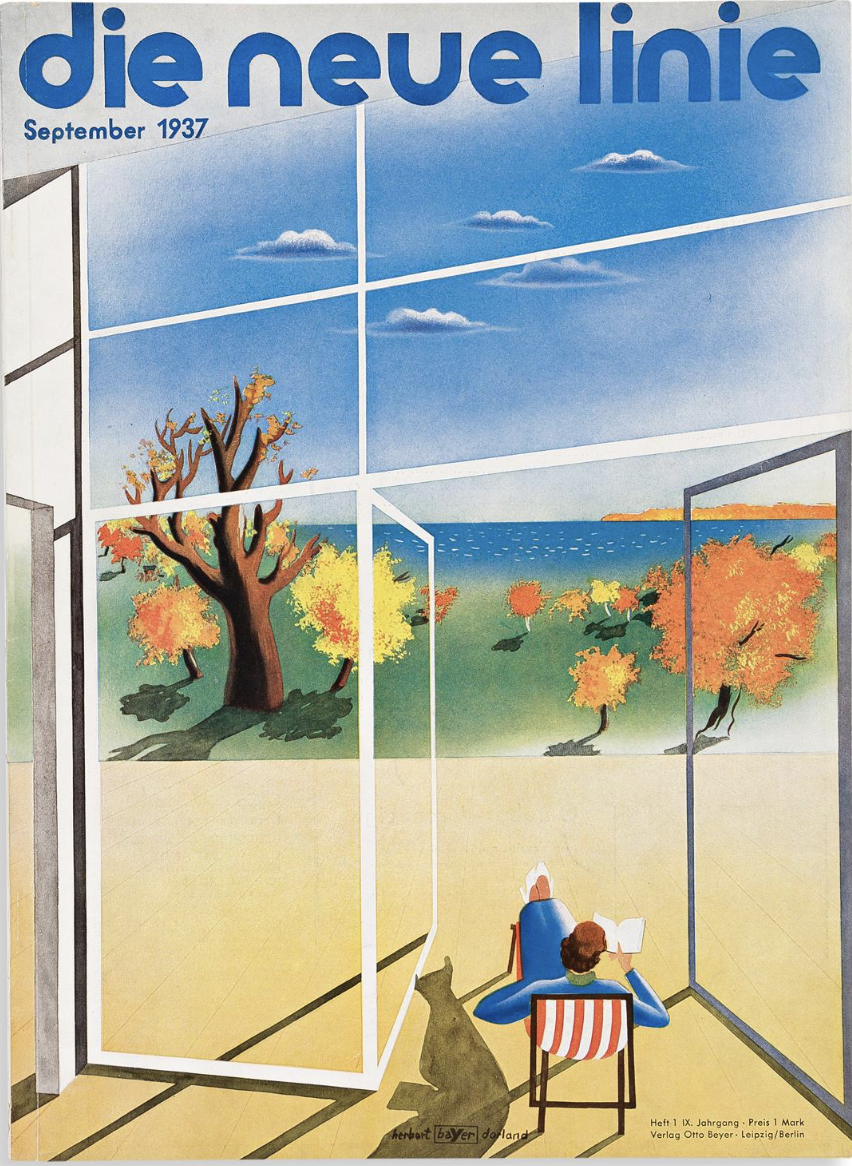
Cover design Herbert Bayer, Source Swann Gallery

 Design is fine. History is mine.