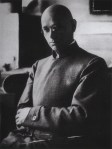
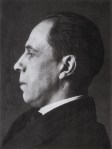
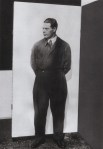
In pictures above: Bauhaus professors Johannes Itten, Theo van Doesburg, László Moholy-Nagy.
Bauhaus founder Walter Gropius searched for teachers in his school, that would not only be qualified artists, but also strong personalities:
“It is naturally vital for everyone that we attract strong, lively personalities whenever possible, even if we do not yet understand them.”
Bauhaus never was a fully finished concept but a flexible system, reflecting new ideals and ever changing circumstances.
Johannes Itten: an expressionist and author of modern theories of colour. He put emphasis on drawing – seeing colour and contrasts, having a real personal experience, understanding of texture and light, feeling art not only through vision but with every nerve: hearing it, tasting it, touching it and having a spiritual experience and memory. His aim was for students to find their own rhythm develop full-rounded personalities, that would help them to stand against the industry as individual artists and artisans.
Theo van Doesburg: painter, poet, writer and architect. He was the founder and leader of De Stijl group, which was anti-expressionist. The ideal was to create logic, functional buildings and furniture that could be sampled. The style was built upon clean lines and shapes, and basic colours: red, blue, yellow + white, grey, black. When he came by Gropius request to Bauhaus, he rated it as ‘expressionist jam’ without any strict discipline, ‘where is even an attempt to create a unified work of art, a unified configuration of space, form, colour?’
László Moholy-Nagy: painter and a photographer. He would be the quickest of all, earning a comment that he is like an eager dog, with no regard for anything. He saw Bauhaus needed a livelier style, to work faster and what mattered the most: produce results. He saw no wrong in employing machines to help men in work – when Germany filched the idea of opening workshops from England, it was out of an economical need after the war, not an ideological belief in handicraft. His personal vision influenced Bauhaus a great deal: minimalism + balanced asymmetry. He sent his students to actual factories and businesses to learn what work looks like and what really is needed. One could say that Moholy brought Bauhaus from theory to practice.
While the three artists were trying to take down each other and revolutionize artistic ideas ever further, they were all equally influential in Bauhaus. As strong personalities as they were, they showed it off with their personal style.
Itten looked like a monk, wearing a special Bauhaus-made outfit; ‘funnel-like trousers, wide at top and narrow at the bottom, a high-necked jacket fastened by a belt of the same material. Itten shaved his head, so that his ‘head is half school-master, half priest… his glasses shouldn’t be forgotten either.’’
Van Doesburg ‘was a vigorous opponent of romantic faddishness. He favoured a stiff black hat and fashionably cut suits.’ He ‘stuck out a monocle, black shirt and white tie’, and in the photography above, posed on a blank background, completely neutral like an object.
Moholy sported red workman’s overalls, which matched his conception of the artist: the designer as technician.
 Design is fine. History is mine.