
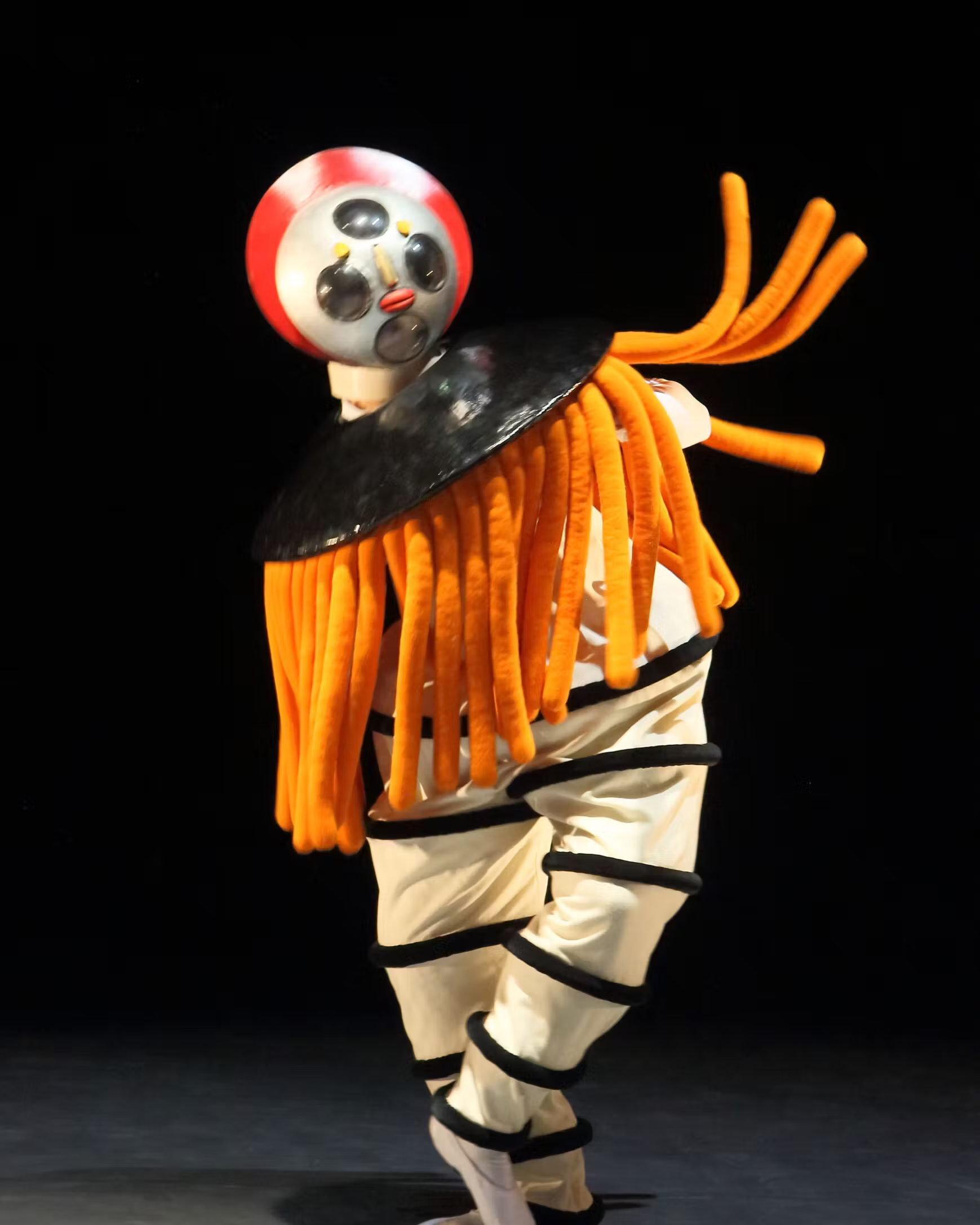


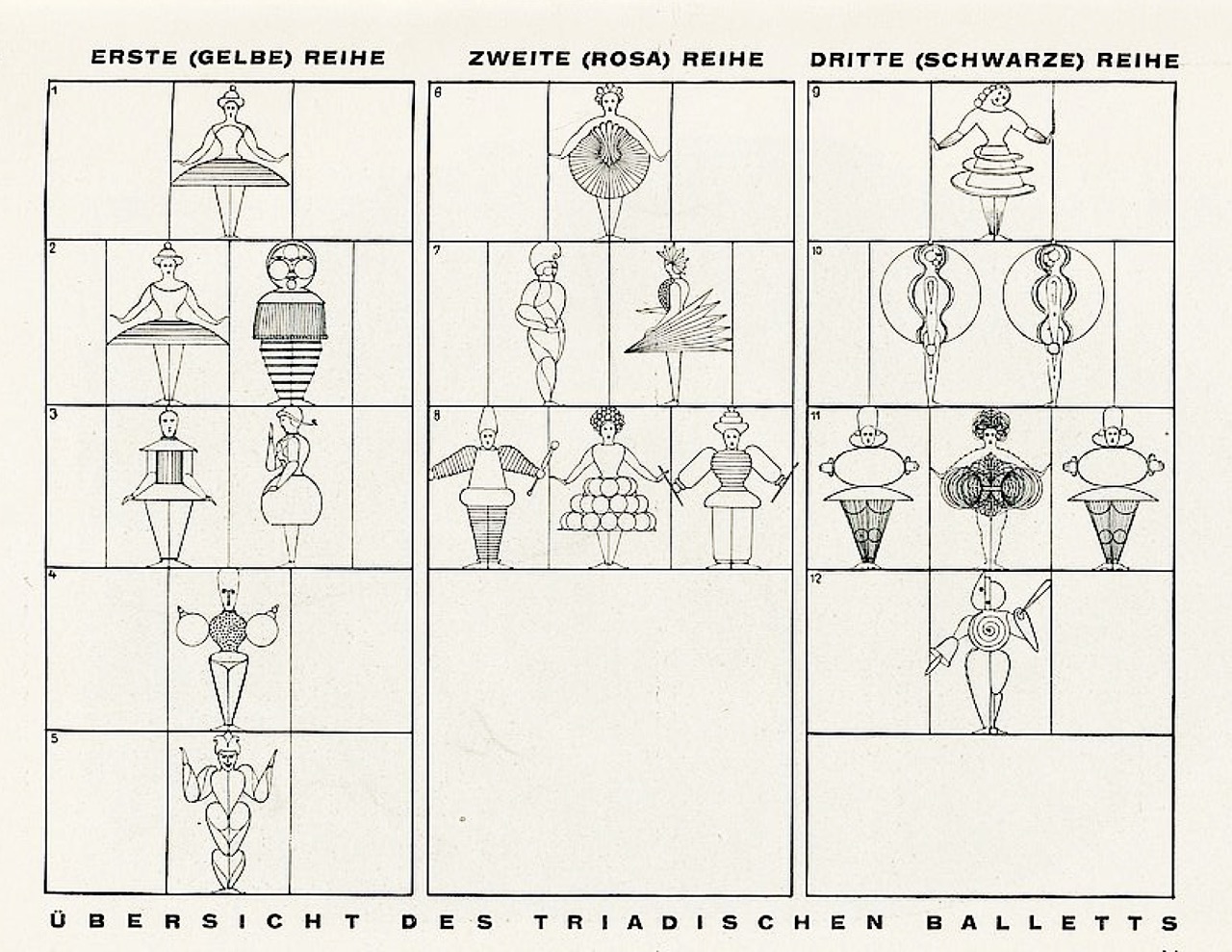
The Triadic Ballet is the most important work in Oskar Schlemmer’s stage art. It premiered on 30 September 1922 at the Württemberg State Theatre in Stuttgart, danced by Albert Burger, Elsa Hötzel and Schlemmer himself, who performed under the pseudonym ‘Walter Schoppe’. Developed as a collaborative work, the Triadic Ballet is characterised by the principle of triplicity, which is applied in several ways: three acts, each with three scenes, danced by three dancers in a total of eighteen costumes against three differently coloured backgrounds (cheerful yellow, festive pink, mystical black) that intensify the mood.
The costumes, made of unusual materials such as sheet steel, plywood or wire, severely restrict the dancers’ movements and have a decisive influence on the forms of movement, creating an intense relationship between figure and space. The costumes transform the human body into abstract figurines and, as Schlemmer himself notes, become ‘spatial sculptures, because they are, so to speak, coloured and metallic sculptures that move in space when worn by dancers […]’. The costume of the ‘diver’ belongs to the cheerful, burlesque first act of the ‘Triadic Ballet’ on a lemon-yellow stage. The individual elements of the costume are designed exclusively in round shapes (circle, sphere, cylinder) and suggest. Source: Staatsgalerie Stuttgart
1/ The Diver/Der Taucher (Papier-mâché, Fabric, Celluloid), photo Staatsgalerie Stuttgart, public domain 2/Dancer: Florian Sollfrank, photo ©Wilfried Hösl 3/From the Bauhaus Book No.4 Die Bühne
5/Figurenplan für das Triadische Ballett, Blatt 2 aus dem Regieheft für Hermann Schergen, Autor: Oskar Schlemmer, 1927. 6/The triadic ballett, group photo. 7/ From the Bauhaus Book Die Bühne
 Design is fine. History is mine.